
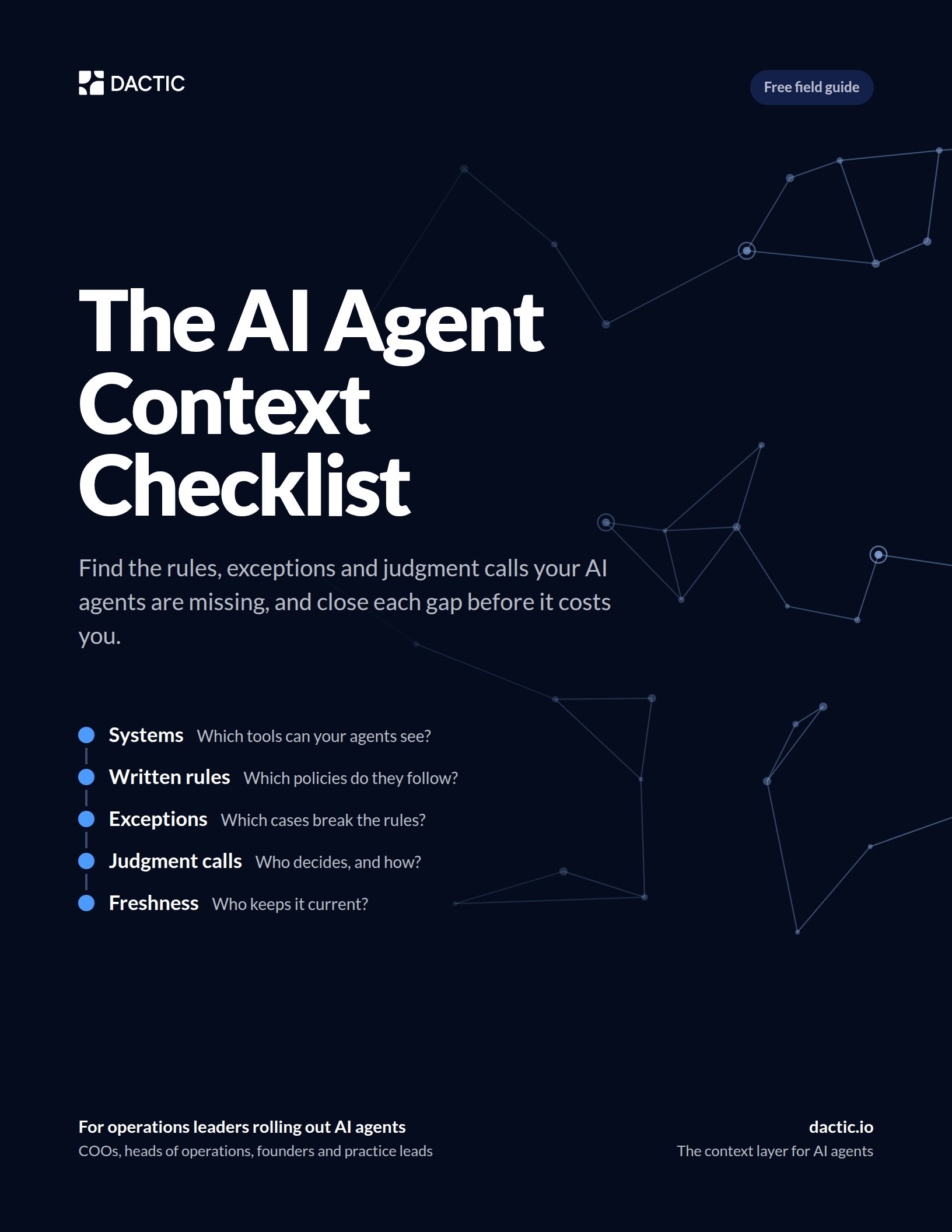
The AI Agent Context Checklist
Your agents already have your documents. This free field guide shows which rules, exceptions and judgment calls they are still missing, and gives you a 30-day plan to close every gap.
- Systems
- Written rules
- Exceptions
- Judgment calls
- Freshness
Agents fail on missing context.
Most AI agents don't fail because the model is weak. They fail because they are missing the rules, exceptions and judgment calls your team carries in its head. Score each line 0, 1 or 2 to see where.
- 0Not captured. It lives in someone's head, or nowhere.
- 1Partly captured. It is written somewhere, but agents can't use it, or it is out of date.
- 2Captured and current. It is written, current, and the agents that need it can use it.
Be honest: a 1 you can fix beats a 2 you can't defend.
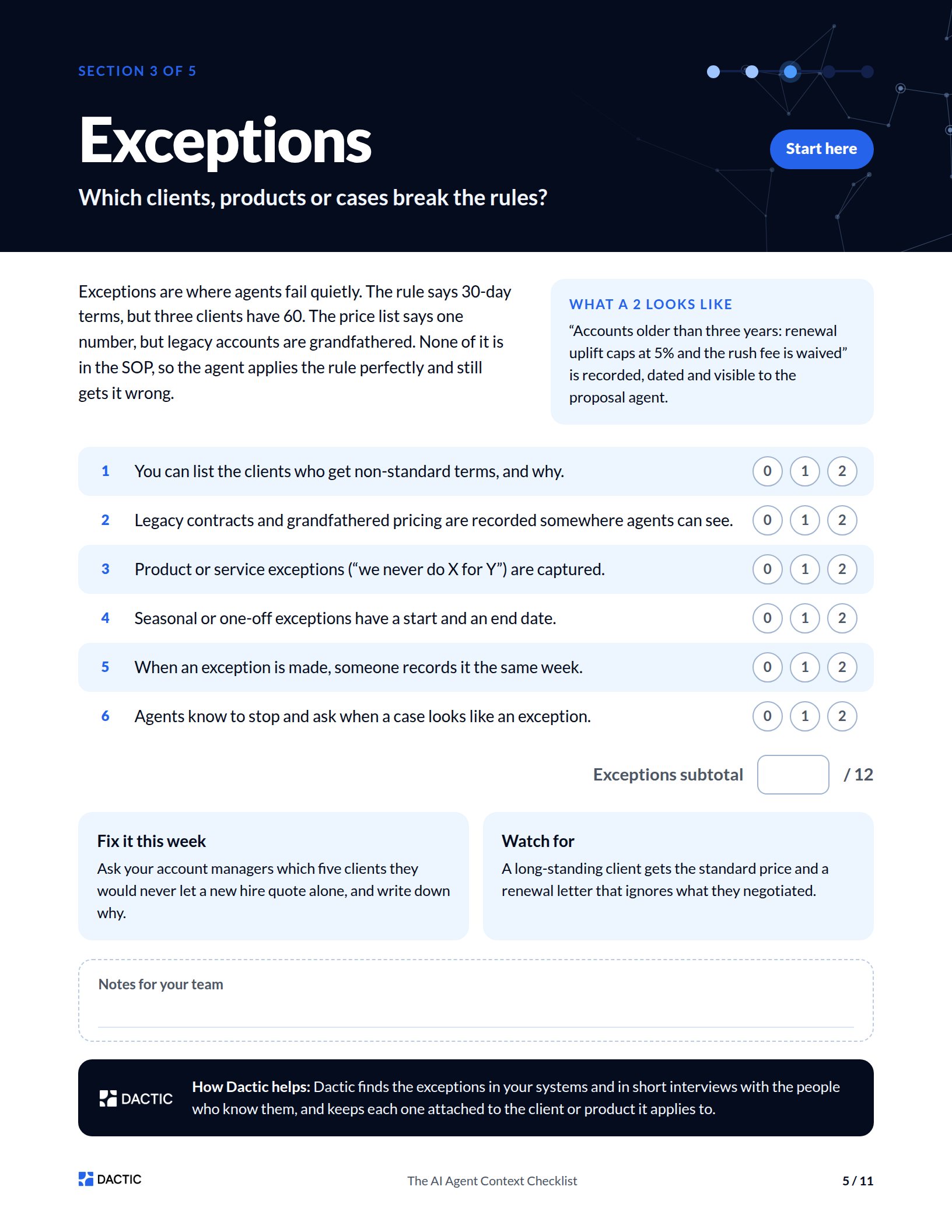
Section 3 of 5
Exceptions
Which clients, products or cases break the rules?
- You can list the clients who get non-standard terms, and why.
- Legacy contracts and grandfathered pricing are recorded somewhere agents can see.
- Product or service exceptions (“we never do X for Y”) are captured.
- Seasonal or one-off exceptions have a start and an end date.
- When an exception is made, someone records it the same week.
- Agents know to stop and ask when a case looks like an exception.
Exceptions subtotal 5 / 12
Five sections, six lines each.
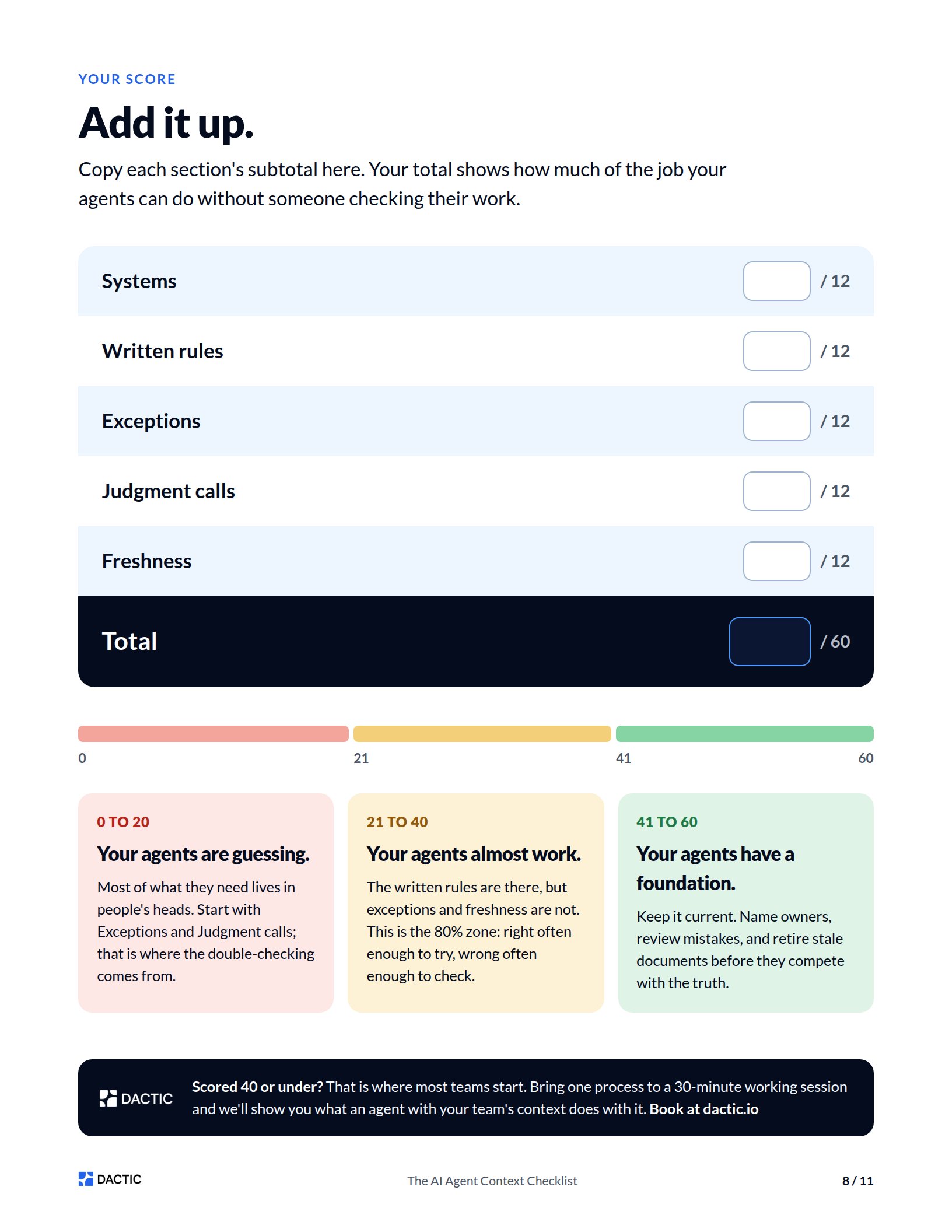
Every section is worth 12 points. Add the subtotals on the scorecard for a score out of 60, then follow the 30-day plan for your range.
Get all 30 linesSystems
6 lines · 12 pointsWhich tools can your agents see?
- Agents can read the CRM records they need for their task.
- Each agent reaches only the systems its task needs, nothing more.
Written rules
6 lines · 12 pointsWhich policies and SOPs do they follow?
- Approval rules (who signs off, and above what amount) are written down.
- When two documents disagree, it is clear which one wins.
Exceptions
6 lines · 12 pointsWhich clients, products or cases break the rules?
- You can list the clients who get non-standard terms, and why.
- Agents know to stop and ask when a case looks like an exception.
Start here. It is the part of your work no document covers.
Judgment calls
6 lines · 12 pointsWho decides, and how?
- How those people decide has been captured, not just what they decided.
- If one of them left tomorrow, their know-how would stay behind.
Freshness
6 lines · 12 pointsWhen did each process last change, and who updates the context?
- Process changes reach the agents within a week.
- Out-of-date documents are retired, not left to compete.
Score five lines now.
One line from each of the five sections. It takes thirty seconds and gives you a rough range; the full checklist has all 30.
Systems
Agents can read the CRM records they need for their task.
Written rules
Approval rules (who signs off, and above what amount) are written down.
Exceptions
You can list the clients who get non-standard terms, and why.
Judgment calls
If the people your team asks left tomorrow, their know-how would stay behind.
Freshness
Process changes reach the agents within a week.
0 / 60
- 0 to 20Your agents are guessing.
- 21 to 40Your agents almost work.
- 41 to 60Your agents have a foundation.
Scored 40 or under?
Bring one process to a 30-minute working session. We'll show you what an agent with your team's context does with it.
- Dactic maps your systems and finds the gaps the checklist points to
- Short interviews capture the judgment calls nobody wrote down
- Every agent's context stays current as your processes change
See it in 90 seconds: one workflow, from connected sources to a deployed agent.
Checklist questions
All questionsIs the checklist really free?
Yes. Fill in the short form and the PDF downloads straight away. We also email you a copy, and you can unsubscribe anytime.
What's inside?
Thirty lines across five sections, a scorecard, what your score means, a 30-day plan to close your biggest gaps, and how Dactic closes them for you.
Who should fill it in?
It is built for COOs, heads of operations, founders and practice leads rolling out AI agents. It works best scored together with the people your team asks when something is unclear.
What does my score mean?
Your total is out of 60, and it falls in one of three ranges:
- 0 to 20: your agents are guessing.
- 21 to 40: your agents almost work.
- 41 to 60: your agents have a foundation.
Where should I start fixing?
With Exceptions and Judgment calls. That is where the double-checking comes from, and it is the part of your work no document covers.
Do I need Dactic to use it?
No. The checklist works on its own. If you score 40 or under, we can show you what an agent with your team's context does with one of your processes.
Find the gaps before your agents do.
Free, practical, and built to be scored with your team. Download it now and score your first section today.